
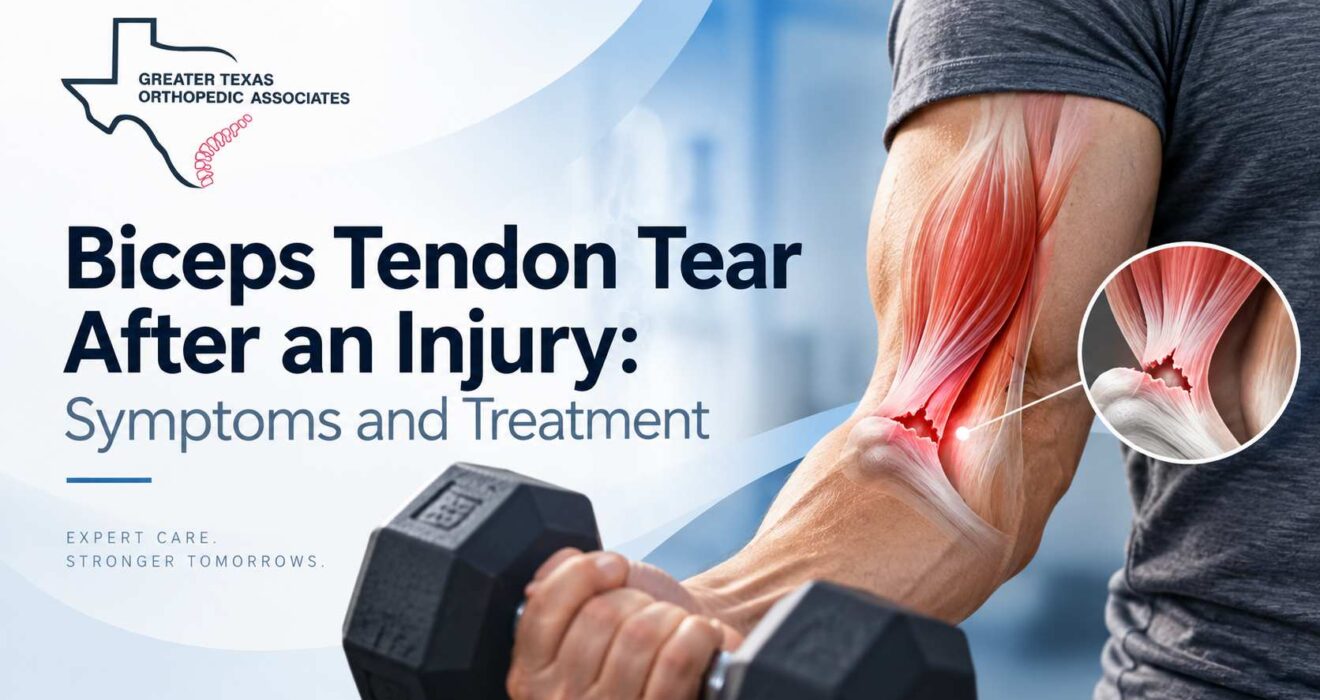
Biceps Tendon Tear After Injury: Symptoms, Treatment & Recovery
A sudden pull, heavy lift, fall, or direct blow can overload the biceps tendon. If the force is strong enough, the tendon may partially tear or pull completely away from its attachment. A biceps tendon tear after injury can occur near the shoulder or elbow, affecting symptoms, strength, treatment, and recovery.
Symptoms, strength loss, and treatment can differ depending on whether the tear occurs near the shoulder or elbow. Proximal tears often preserve useful arm function, while complete distal tears can cause greater weakness with lifting and palm-up rotation. Orthopedic evaluation helps determine whether the tear is partial or complete and whether rehabilitation or surgery should be considered.
What Is a Biceps Tendon Tear?
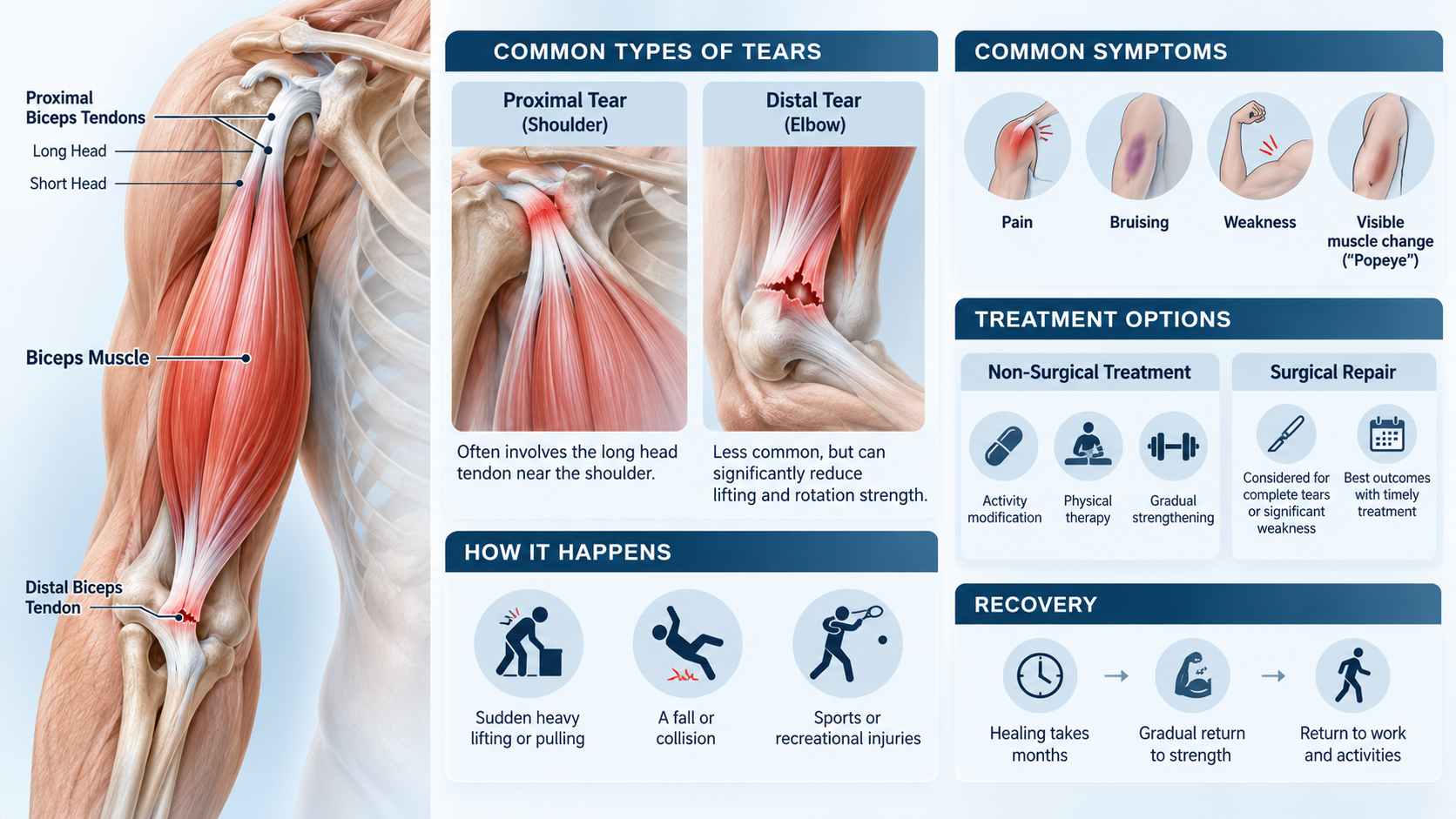
The biceps bends the elbow and rotates the forearm so the palm faces upward. Two proximal tendons attach near the shoulder, while the distal tendon attaches near the elbow. Most proximal tears involve the long head; distal tears are less common but can cause greater strength loss.
A biceps tendon tear may be partial, with some fibers intact, or complete, with the tendon fully separated from its attachment.
How Does a Biceps Tendon Tear Happen?
Acute tears often occur when the biceps is contracting and the arm is forced the opposite way. This can happen while catching a falling object, lifting an unexpected load, bracing during a fall, or resisting a force that suddenly straightens the elbow.
Common Injury Mechanisms
- Forceful lifting or pulling when the arm is under unexpected resistance
- A fall, collision, or sudden traction force involving the shoulder or elbow
- Sports, workplace, or recreational injuries that place abrupt stress on the tendon
- Symptoms to Watch for After an Arm Injury

A tear can be missed when pain improves but weakness remains with lifting or forearm rotation. Symptoms vary by location and severity, but some patients also notice a visible change in the shape of the upper arm or a loss of strength when lifting, pulling, or rotating the forearm.
Signs That Suggest More Than a Strain
Ongoing weakness or a new contour change deserves attention even as pain decreases. Persistent weakness after an injury may indicate a biceps tendon tear, especially when strength does not return as expected.
Distal Biceps Tendon Tear Symptoms
Typical distal biceps tendon tear symptoms include front-of-elbow pain, bruising into the forearm, tenderness, and weakness. This motion, called supination, is one of the functions most affected when the distal biceps tendon is completely torn.
Why Forearm Rotation Weakness Matters
A clinician may compare both arms and assess tendon continuity, elbow flexion, forearm rotation, muscle contour, and strength. These findings help distinguish a distal tear from a strain or another source of elbow pain.
Persistent distal biceps tendon tear symptoms after trauma may justify imaging when the diagnosis is uncertain. Early recognition matters when a complete rupture is suspected.
Proximal Biceps Tears Near the Shoulder
Proximal tears usually involve the long head of the biceps. Pain may occur at the front of the shoulder or upper arm with bruising, tenderness, cramping, or a visible bulge.
Why Proximal Tears Can Behave Differently
Because another proximal attachment remains, many people preserve useful elbow function after an isolated long-head rupture. That is why surgery is not required for every biceps tendon tear after injury near the shoulder. Shoulder pain after trauma can also involve the rotator cuff, labrum, or other structures.
How Is a Biceps Tendon Tear Diagnosed?
Diagnosis begins with how the injury happened and what changed afterward. The clinician may ask about arm position, the force involved, a pop, bruising, and which activities became difficult.
The examination evaluates tenderness, muscle contour, motion, elbow strength, forearm rotation, and shoulder function. Specific maneuvers may test whether the distal tendon remains attached.
When Imaging Is Needed
X-rays do not show tendon fibers but can exclude fractures or other bone injuries. Ultrasound can help assess tendon continuity or retraction, while MRI can show partial or complete tears and associated soft tissue injuries.
During an orthopedic evaluation, the physician can compare the reported mechanism with the patient’s strength, range of motion, functional limitations, and imaging findings.
Partial Tear Versus Complete Rupture
Partial tears can be harder to recognize because some fibers remain connected. Pain with resisted motion, reduced endurance, tenderness, or weakness may be more useful than pain at rest.
Why Movement Does Not Rule Out a Complete Tear
A complete rupture causes greater structural disruption, but movement may still be possible because other muscles assist elbow flexion and shoulder function. Being able to bend the arm does not rule out a significant tendon rupture.
The key questions are whether the tendon remains intact and how much strength and forearm rotation have been lost. Distinguishing partial from complete tears helps guide treatment.
Torn Biceps Treatment Without Surgery
Torn biceps treatment depends on location and whether the tear is partial or complete. Many proximal long-head ruptures and selected partial tears can be treated nonsurgically when functional loss is limited.
What Conservative Care May Include
Early care may include activity modification, symptom control, and protection from heavy loading. As symptoms improve, therapy can restore motion before strengthening progresses. Rehabilitation should follow function rather than force painful resistance.
When Is Surgical Repair Considered?
Surgery may be considered when a tear causes significant weakness or persistent functional limits. Complete distal ruptures are different because loss of the attachment can weaken palm-up rotation and elbow strength.
Why Timing Can Matter for Distal Tears
For active patients who rely on lifting, pulling, or tool use, restoring the distal attachment may provide functional benefit. Timing matters because the tendon can retract and scar, making delayed repair more complex.
Who May Benefit Most From Surgical Repair?
Selected proximal tears may require surgery when symptoms remain substantial or another shoulder condition needs operative treatment. Treatment decisions depend on tear location, functional demands, symptoms, overall health, and the amount of strength loss.
Rehabilitation and Biceps Tendon Rupture Recovery
Biceps tendon rupture recovery varies with tear location, severity, treatment, associated injuries, and physical demands. A partial proximal tear follows a different course from a surgically repaired complete distal rupture.
Early Protection and Controlled Motion
After surgical repair, the tendon needs time to heal securely. Rehabilitation typically begins with protection and controlled motion, followed later by progressive resistance. Heavy lifting is not resumed simply because pain has improved. Patients who want to understand how tendon healing progresses can also read GTOA’s guide to tendon rupture recovery, which explains the role of staged rehabilitation after a major tendon injury.
Return to Work, Lifting, and Sports
Recovery is usually measured in months. Daily tasks may return before heavy work or sports. Before unrestricted activity, the arm should have enough motion, strength, and endurance for its demands. These milestones are central to biceps tendon rupture recovery.
Why Medical Documentation Matters After a Traumatic Biceps Tear
After a collision, fall, workplace incident, or other trauma, timely medical documentation can show what changed. Records may capture the mechanism, symptoms, bruising, deformity, strength loss, motion, imaging findings, and response to treatment.
What Follow-Up Records Can Show
Follow-up visits document healing, persistent weakness, and when work or activity restrictions can safely change.
When Should You Seek Orthopedic Care?
A sudden pop followed by bruising, deformity, marked weakness, or difficulty rotating the forearm warrants medical attention. Evaluation is also appropriate when pain improves but strength does not return.
A biceps tendon tear after injury can range from a partial injury managed conservatively to a complete rupture that may need timely surgical consideration. Whether the tendon is partially torn, completely ruptured, or still attached can change treatment decisions.
If an arm injury continues to interfere with work, lifting, exercise, or everyday activities, contact GTOA to discuss evaluation and appropriate next steps.
Frequently Asked Questions About Biceps Tendon Tears
These questions address common concerns after a traumatic biceps injury.
Can a Biceps Tendon Tear Be Treated Without Surgery?
Some partial tears and many proximal long-head tears can improve with activity modification and rehabilitation. Complete distal ruptures may be treated differently when strength loss affects lifting, work, or everyday arm function.
What Are Common Symptoms?
Symptoms can include sudden pain, bruising, tenderness, weakness, a visible change in arm shape, and difficulty lifting or rotating the palm upward against resistance.
How Long Does Biceps Tendon Recovery Take?
Recovery depends on tear location, severity, treatment, and physical demands. After surgical repair, rehabilitation progresses gradually, and unrestricted lifting or athletic activity may take several months.
When Should I Seek Orthopedic Care?
Seek orthopedic evaluation after a sudden pop, significant bruising, visible deformity, persistent weakness, or difficulty lifting and rotating the forearm. Early assessment can help clarify the injury and appropriate treatment options.
Recovering From a Biceps Tendon Tear After Injury
A torn biceps tendon can affect lifting power, forearm rotation, endurance, appearance, and daily function. Persistent weakness can remain important even after the initial pain improves.
After a biceps tendon tear, the key questions are where the tendon is damaged, whether the tear is partial or complete, and how much function has been lost. Those findings guide rehabilitation, surgery, and return to activity.
This article provides general educational information and does not replace an individual medical evaluation.