
Elbow Fracture After a Fall: Symptoms, Treatment, and Recovery
An elbow fracture after a fall can happen when someone lands directly on the elbow or reaches out with a hand to break the fall. Either mechanism can send force through the joint and fracture the lower humerus, radial head, or upper ulna. The injury may be a stable break or involve displaced fragments and joint instability.
Pain, swelling, bruising, and difficulty moving the arm are common, but symptoms do not always reveal the severity of the injury. Because this joint can become stiff after trauma, accurate diagnosis and appropriately timed treatment are important for restoring useful motion and strength.
How a Fall Can Cause an Elbow Fracture
The elbow is formed where the humerus meets the radius and ulna. The landing mechanism often influences the injury pattern.
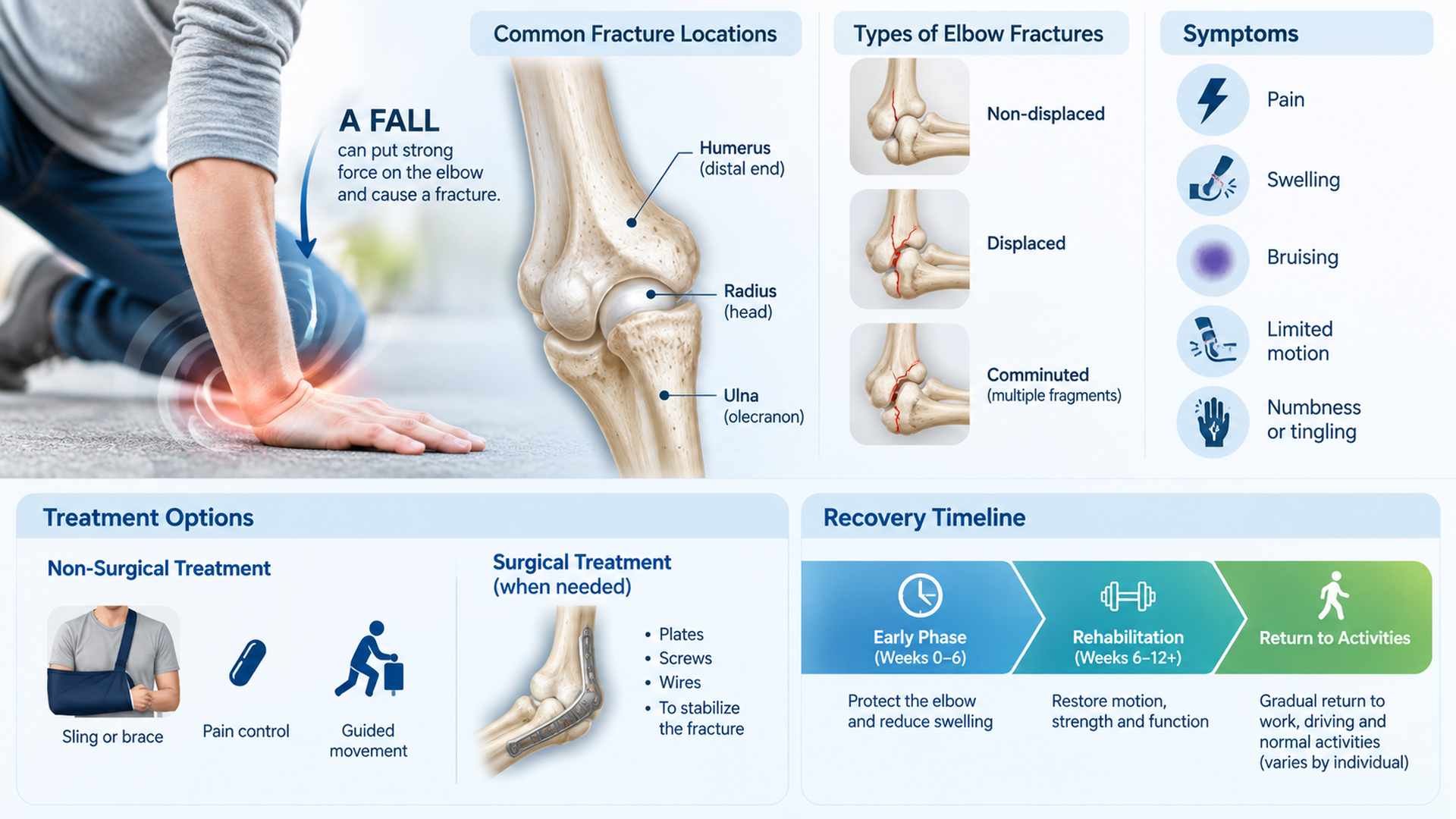
A direct impact on the point of the elbow can fracture the olecranon, the prominent upper portion of the ulna. Falling onto an outstretched hand can transmit force through the forearm and injure the radial head. Greater force may damage the distal humerus or cause combined bone and soft-tissue injuries.
An elbow fracture after a fall can be nondisplaced, with fragments remaining in good alignment, or displaced, with fragments shifted from their normal position. Comminuted fractures involve several pieces. An open fracture communicates with a skin wound and requires urgent care because of infection risk.
A significant fall can fracture healthy bone, while a lower-energy fall may cause a substantial injury in someone with osteoporosis. Similar concerns apply when evaluating a hip fracture after a fall, particularly in older adults.

Broken Elbow Symptoms After a Fall
Broken elbow symptoms usually begin soon after injury, although bruising and swelling may increase over the following hours. Pain may be concentrated at the back or outside of the joint, or harder to localize when several structures are injured.
- Sudden elbow pain with swelling, bruising, or marked tenderness after the fall
- Difficulty bending or straightening the elbow, rotating the forearm, gripping, or using the arm normally
- Visible deformity, an open wound, numbness or tingling in the hand, or a feeling that the elbow is unstable
Not every fracture causes obvious deformity. A small radial head fracture may primarily cause pain when turning the palm upward or downward. Persistent focal tenderness and loss of normal function deserve evaluation even when the elbow does not look severely injured.
MedlinePlus notes that elbow injuries may cause pain, swelling, stiffness, and limited movement, and that some symptoms can worsen after the initial injury.
When Symptoms Need Urgent Attention
Certain symptoms require urgent medical evaluation. These include an open wound, obvious deformity, severe or rapidly increasing swelling, uncontrolled bleeding, worsening numbness, or a hand that becomes unusually pale, cold, or weak. Such findings may indicate significant displacement or injury to nerves or blood vessels.
How an Elbow Fracture Is Diagnosed
Diagnosing an elbow fracture after a fall starts with understanding how the person landed. A direct blow creates a different injury pattern from a fall onto an outstretched hand, so the mechanism provides useful clinical context.
During examination, a clinician checks for tenderness, swelling, bruising, wounds, deformity, and restricted motion. Sensation, finger movement, pulses, and circulation can help identify associated nerve or vascular injury.
X-rays are typically the first imaging study. They can show fracture location, alignment, displacement, and associated joint injuries. However, a small fracture, particularly around the radial head, may not always be obvious initially.
If the examination still suggests a fracture despite uncertain imaging, additional views, repeat imaging, or advanced imaging may be appropriate. CT provides greater detail for complex fractures and can assist with surgical planning.
MRI is not routinely required for a clearly visible acute elbow fracture, but it may be considered when associated soft-tissue, ligament, tendon, or occult injury remains a concern. A comprehensive orthopedic evaluation considers the mechanism, examination, imaging, and functional limitations together rather than relying on an X-ray alone.
Elbow Fracture Treatment
Elbow fracture treatment depends on fracture location, displacement, joint stability, skin condition, and involvement of nearby nerves, blood vessels, ligaments, or cartilage. Patient health and activity demands may also influence the plan.
Initial care for an elbow fracture after a fall often includes supporting the arm in a splint or sling while pain and swelling are addressed. Instructions regarding movement, medication, ice, and elevation should be individualized to the injury and the patient’s medical circumstances.
Nonsurgical Treatment
Stable fractures with little or no displacement can sometimes heal without surgery. Depending on the fracture pattern, a sling, splint, or brace may be used temporarily, followed by carefully timed movement.
Repeat X-rays may be needed to confirm that the fracture remains aligned. This matters because a fracture that initially appears stable can sometimes shift.
Immobilization protects healing bone, but keeping the elbow still too long can cause substantial stiffness. For this reason, treatment often introduces safe movement once fracture stability permits rather than waiting for every symptom to disappear.
When Surgery May Be Necessary
Surgery becomes more likely when fragments are significantly displaced, the joint is unstable, several fragments are present, important joint surfaces are disrupted, or the fracture is open. Certain olecranon and distal humerus fractures frequently require fixation to restore alignment and joint mechanics.
Plates, screws, wires, or other devices may hold the bone in position while it heals. The goal is not simply better alignment on an X-ray. Treatment should provide a stable, functional elbow capable of safe movement and progressive loading.
Elbow Fracture Recovery and Rehabilitation
Elbow fracture recovery varies from one patient to another. A stable fracture may progress relatively quickly, while a displaced fracture requiring surgery can take longer. Bone healing generally occurs over several weeks, but regaining motion, strength, endurance, and confidence in the arm may continue for several months.
Early recovery focuses on protecting the fracture, managing swelling, and monitoring healing. Once movement is considered safe, rehabilitation can gradually progress from range-of-motion exercises toward strengthening.
Prolonged immobilization can contribute to significant elbow stiffness, so safe movement is often introduced once fracture stability allows. Difficulty fully straightening the arm can remain even when the bone is healing normally. This may affect reaching, dressing, driving, carrying groceries, lifting, and work activities.
Physical or occupational therapy may be recommended to improve movement and strength. Rehabilitation should progress according to fracture stability and healing rather than forcing the joint through significant pain.
Successful recovery is measured by more than bone union on an X-ray. Restoring safe, useful function for everyday activities is equally important.
Returning to Driving, Work, and Normal Activity
After an elbow fracture after a fall, patients often want a specific date for returning to normal activity, but recovery does not follow one universal schedule.
Driving requires sufficient arm control and the ability to react safely without restrictions from a sling or impairing medication. Desk work may be possible sooner than work involving repetitive lifting, pushing, pulling, climbing, tools, or heavy objects.
Before heavier activity resumes, clinicians may consider tenderness, range of motion, strength, fracture stability, imaging evidence of healing, and physical demands. Pain may improve before the bone is ready for unrestricted loading, so feeling better alone is not always a reliable clearance test.
Possible Complications During Recovery
Most patients with an elbow fracture after a fall improve with appropriate care, but complications can occur. Persistent stiffness is among the most common concerns. Other potential problems include delayed healing, nonunion, infection, hardware irritation, nerve symptoms, weakness, and post-traumatic arthritis.
New or worsening numbness, increasing swelling, fever, wound drainage, progressive deformity, or unexpected loss of motion should be reassessed rather than assumed to be part of normal elbow fracture recovery.
Why Follow-Up Matters
Follow-up after an elbow fracture after a fall helps confirm that the bone is healing appropriately and whether normal function is returning.
Final Thoughts
An elbow fracture after a fall can range from a small stable break to a complex joint injury. Recognizing broken elbow symptoms, obtaining appropriate imaging, and choosing care based on the fracture pattern can make an important difference in long-term function.
Some patients need temporary immobilization followed by progressive movement, while others require surgery and longer rehabilitation. Appropriate elbow fracture treatment should support healing while preserving as much useful motion and strength as possible.
Still Having Elbow Pain or Limited Motion After a Fall?
Greater Texas Orthopedic Associates can evaluate persistent elbow pain, swelling, stiffness, and loss of function after an injury, review available imaging, and help determine appropriate next steps in care.
Schedule an Orthopedic Evaluation
FAQs About Elbow Fractures After Falls
Can You Move Your Elbow If It Is Fractured?
Yes. Some small or nondisplaced fractures still allow partial movement. Being able to bend the elbow does not rule out a fracture, especially when pain, focal tenderness, swelling, or difficulty rotating the forearm continues.
How Long Does a Fractured Elbow Take to Heal?
Healing time varies according to fracture type, displacement, treatment, age, bone quality, and associated injuries. Bone healing may take several weeks, while comfortable motion and strength can take longer to return.
When Should You Seek Urgent Care for an Elbow Injury?
Seek prompt medical attention for severe deformity, an open wound, worsening numbness, major swelling, uncontrolled bleeding, or a pale or cold hand after injury, especially following a significant fall or impact.
What Happens If an Elbow Fracture Is Left Untreated?
A displaced or unstable fracture may heal in poor alignment, remain unstable, or contribute to chronic stiffness, weakness, pain, and joint problems. Persistent symptoms after a fall should be evaluated rather than managed only by waiting for pain to improve.
This article is for educational purposes and is not a substitute for an individual medical evaluation.